Support our educational content for free when you purchase through links on our site. Learn more
Are OLED TVs Better Than LED TVs? 9 Must-Know Facts (2025) 📺

If you’ve ever stood in front of a TV aisle, dazzled by the glow of countless screens, you’ve probably asked yourself: Are OLED TVs really better than LED TVs? It’s the classic showdown of display tech, with passionate fans on both sides. But here’s the kicker — the answer isn’t as simple as you might think. From perfect blacks to blazing brightness, and from gaming performance to burn-in fears, this guide unpacks 9 essential facts that will help you decide which TV technology truly deserves your living room throne in 2025.
We’ll take you behind the scenes of OLED’s self-lighting pixels, Samsung’s quantum dot wizardry, and the latest Mini-LED marvels in Neo QLEDs. Plus, we’ll reveal which TV tech suits your unique viewing habits — whether you’re a cinephile craving cinematic depth, a gamer chasing ultra-smooth action, or someone battling bright-room glare. Ready for the ultimate TV tech face-off? Let’s dive in!
Key Takeaways
- OLED TVs deliver perfect blacks and infinite contrast thanks to self-emissive pixels, making them ideal for dark-room movie lovers and gamers.
- LED TVs, especially Samsung’s QLED and Neo QLED, excel in brightness and color volume, perfect for bright rooms and vivid HDR content.
- Burn-in risk on OLED is minimal for typical users, but Neo QLED offers peace of mind with zero image retention.
- Gaming performance is stellar on both OLED and Neo QLED, with OLED offering near-instant pixel response and Neo QLED providing high brightness and no burn-in.
- Budget-conscious buyers get excellent value from LED and QLED TVs, with brands like TCL and Hisense delivering feature-rich options.
- Smart TV platforms, audio quality, and connectivity features matter just as much as panel tech for a great overall experience.
👉 Shop Top TVs:
- LG OLED TVs: Amazon | Walmart | LG Official Website
- Samsung QLED & Neo QLED TVs: Amazon | Walmart | Samsung Official Website
- TCL & Hisense LED TVs: Amazon | Walmart
Table of Contents
- ⚡️ Quick Tips and Facts
- 📺 The Evolution of Display Technology: From LCD to OLED and Beyond
- 🔥 The Great Display Debate: Are OLED TVs Truly Better Than LED TVs?
- ⚔️ Head-to-Head Showdown: OLED vs. LED vs. QLED vs. Neo QLED – A Deep Dive into Picture Quality
- ⚫️ Black Levels and Contrast: The Ultimate Battle for Depth
- 🎨 Color Accuracy and Volume: A Spectrum of Vibrancy
- ☀️ Brightness and HDR Performance: Shining Light on Your Content
- 📐 Viewing Angles: Sharing the Perfect Picture
- 🎮 Motion Handling and Gaming: Smooth Moves and Low Latency
- 🔥 Burn-in Concerns: Fact vs. Fiction for OLED Displays
- ⚡️ Energy Efficiency: Powering Your Entertainment
- 🖼️ Design and Aesthetics: Slim Profiles and Sleek Looks
- 🤔 Which TV Technology is Right for YOU? Tailoring Your Choice to Your Viewing Habits
- 🌟 Exploring the Top Contenders: Brand-Specific Insights
- ⚙️ Beyond the Panel: Essential TV Features to Consider
- ✅ Quick Tips for TV Shopping Success!
- 🏆 Conclusion: The Verdict on Your Next TV Upgrade
- 🔗 Recommended Links for Further Exploration
- ❓ Frequently Asked Questions (FAQ) About TV Technologies
- 📚 Reference Links: Our Sources and Research
Here at TV Brands™, we’ve spent countless hours bathed in the glow of countless screens, all in the name of helping you find the perfect television. The question we get more than any other? “Seriously, are OLED TVs really that much better than LED TVs?” It’s the heavyweight championship of the TV world, a clash of titans in technology. And let us tell you, the answer isn’t just a simple yes or no. It’s a spectacular “it depends!”
So, grab your popcorn 🍿, settle into your favorite armchair, and let’s dive deep into the pixels and photons to finally settle the score.
⚡️ Quick Tips and Facts
In a hurry? Here’s the lightning round of what you need to know. We’ll unpack all of this glorious tech jargon further down.
- OLED stands for Organic Light Emitting Diode. Each tiny pixel makes its own light. When it needs to be black, it just switches off completely. Think of it as a stadium full of fans who each have a flashlight they can turn on, off, or change the color of individually.
- LED TVs are technically LCD TVs. They use a Liquid Crystal Display (LCD) panel that’s lit from behind by Light Emitting Diodes (LEDs). It’s more like shining a giant spotlight through a stained-glass window.
- ⚫️ Perfect Blacks = Infinite Contrast: Because OLED pixels can turn completely off, they create perfect black. This leads to what we call “infinite contrast,” making colors pop in a way that’s simply breathtaking. As one source notes, “These self-lit pixels can turn themselves off when needed, allowing the TV to produce pure blacks.”
- ☀️ Brightness Battle: Generally, high-end LED TVs (especially QLED and Neo QLED models) can get significantly brighter than OLEDs. This makes them fantastic for sunny, bright rooms. ZDNET points out that while OLEDs peak around 1,000 nits, some LEDs can reach a searing 5,000 to 8,000 nits.
- 🌈 Color Kings: QLED TVs (a type of LED TV from Samsung and others) use a layer of “quantum dots” to produce incredibly vibrant and a wider range of colors, especially at high brightness levels.
- 🎮 Gamers’ Paradise: Both technologies offer fantastic options for gaming. OLEDs have near-instantaneous pixel response times for zero motion blur, while some high-end LED TVs offer faster refresh rates.
- 🔥 The “Burn-In” Question: OLEDs have a theoretical risk of “burn-in” or image retention if a static image (like a news ticker) is left on screen for extreme lengths of time. However, modern OLEDs have many built-in technologies to prevent this, and for most users, it’s not a concern.
- 💰 Price Point: LED TVs are the undisputed champions of affordability. You can find a great LED TV for a fraction of the cost of a comparable OLED, making them a fantastic choice for those on a budget.
📺 The Evolution of Display Technology: From LCD to OLED and Beyond
Remember those bulky CRT TVs that took up half the living room? We’ve come a long, long way! The journey to the ultra-thin, stunning displays we have today is a fascinating tale of technological leaps. First came the flat-panel LCDs, which were a revelation. But they needed a chunky, power-hungry fluorescent backlight.
Then, the game changed. Engineers figured out how to replace those bulky backlights with tiny, efficient Light Emitting Diodes (LEDs). This is the birth of the “LED TV” as we know it. It allowed for slimmer designs, better energy efficiency, and more precise light control. This is the core TV Technology that still dominates the market today.
But the engineers didn’t stop there. They dreamt of a display where every single pixel could be its own light source, eliminating the need for a backlight entirely. That dream became OLED, a revolutionary step forward that unlocked a new level of picture quality. And just when we thought things couldn’t get any better, brands like Samsung pushed the LED model even further with QLED and Neo QLED, creating a truly competitive landscape.
🔥 The Great Display Debate: Are OLED TVs Truly Better Than LED TVs?
This is the main event, folks! To understand which is “better,” you first need to understand how they fundamentally work. It’s not just about the final picture; it’s about the magic happening behind the screen.
💡 Understanding the Basics: What is LED TV Technology?
Let’s clear up a common misconception: an LED TV is an LCD TV. It uses a panel of liquid crystals (the “LC” in LCD) to create the image, but the light source that shines through that panel is a grid of LEDs.
- How it works: The LEDs provide the backlight. The LCD panel acts like a set of tiny shutters, opening and closing to let light through and blocking it to create the image. Color filters then give each pixel its specific hue.
- Local Dimming: To create deeper blacks, better LED TVs use a feature called “local dimming.” They divide the LED backlights into “zones” that can be dimmed or brightened independently. The more zones, the more precise the control, and the better the contrast. Early models had maybe a dozen zones; modern high-end sets can have thousands!
✨ The Brilliance of OLED: How Self-Emitting Pixels Transform Your View
OLED is a different beast entirely. There is no backlight. Zero. None. Instead, each of the millions of pixels in an OLED screen is made from an organic compound that lights up when you apply electricity.
- Pixel-Perfect Control: Because each pixel is its own light source, it can be turned on or off completely independently. This is the secret to OLED’s legendary picture quality.
- The Power of “Pure Black”: When a scene calls for black, the OLED pixels in that area simply switch off. They emit no light. This is what we call “perfect” or “pure black.” This ability creates a level of contrast and depth that makes images look incredibly lifelike and three-dimensional. It’s something you truly have to see to believe.
🌈 QLED Unpacked: Samsung’s Quantum Dot Revolution
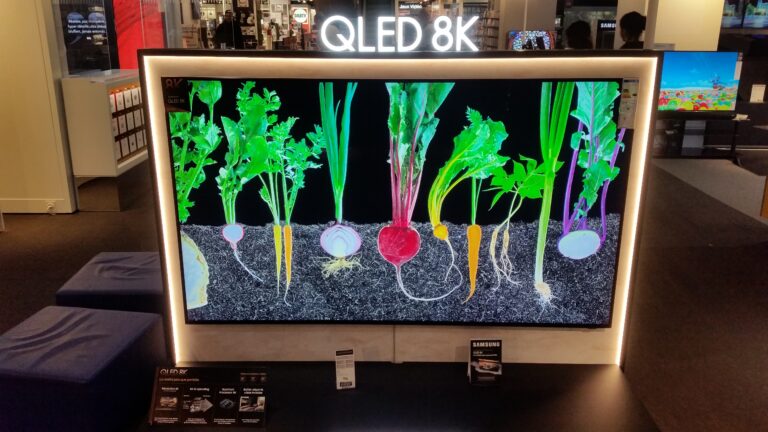
Just as OLED was taking the world by storm, Samsung fired back with QLED. QLED is not a self-emissive technology like OLED. It’s a very advanced type of LED TV.
- What are Quantum Dots? The “Q” in QLED stands for Quantum Dot. These are microscopic nanocrystals that, when hit by light, emit their own intensely pure colored light.
- How it works: A QLED TV adds a film of these quantum dots between the LED backlight and the LCD panel. This allows the TV to produce a much wider and more accurate range of colors and achieve incredible brightness levels.
🚀 Neo QLED: Mini-LEDs Taking Samsung’s QLED to the Next Level
The latest evolution in the LED world is Mini-LED, which Samsung brands as Neo QLED. This technology takes the traditional LED backlight and shrinks the LEDs down to a microscopic size.
- The Mini-LED Advantage: Because the LEDs are so much smaller, you can fit thousands more of them behind the panel. This, combined with a massive increase in local dimming zones, gives the TV incredibly precise control over which parts of the screen are bright and which are dark. As CNET puts it, the contrast is “not pixel-perfect like OLED, but close enough.” This technology is a direct answer to OLED’s contrast advantage.
⚔️ Head-to-Head Showdown: OLED vs. LED vs. QLED vs. Neo QLED – A Deep Dive into Picture Quality
Alright, let’s put these technologies in the ring and see how they stack up across the key categories that actually matter to your eyeballs.
| Feature | OLED (e.g., LG C3, Sony A95L) | LED (e.g., TCL 4-Series) | QLED (e.g., Samsung Q80C) | Neo QLED (e.g., Samsung QN90C) |
|---|---|---|---|---|
| Black Levels | ✅ Perfect / Infinite | ❌ Good (can look gray) | ✅ Very Good | ✅ Excellent (near-OLED) |
| Contrast | ✅ Best in Class | ❌ Fair | ✅ Very Good | ✅ Excellent |
| Peak Brightness | ❌ Good | ✅ Good | ✅ Excellent | ✅ Best in Class |
| Color Volume | ✅ Excellent | ❌ Good | ✅ Best in Class | ✅ Best in Class |
| Viewing Angle | ✅ Excellent | ❌ Poor to Fair | ✅ Good | ✅ Very Good |
| Motion Handling | ✅ Excellent | ✅ Good | ✅ Very Good | ✅ Excellent |
| Burn-In Risk | ❌ Low (but possible) | ✅ None | ✅ None | ✅ None |
⚫️ Black Levels and Contrast: The Ultimate Battle for Depth
This is OLED’s signature move. The knockout punch. When you watch a movie like Gravity or The Batman, the blackness of space or the shadows of Gotham are truly, deeply black. Not a milky gray, but an inky void. This makes every other color on screen pop with incredible vibrancy. CNET states that for the best picture quality, “OLED TVs are the way to go” precisely because of these perfect black levels.
Neo QLED TVs have made incredible strides here. With their thousands of Mini-LEDs and dimming zones, they get very close to OLED’s performance, but you can sometimes still see a faint halo or “blooming” around bright objects on a dark background. Standard LED TVs, especially those without local dimming, struggle the most in this category.
Winner: OLED
🎨 Color Accuracy and Volume: A Spectrum of Vibrancy
While OLEDs have fantastic color accuracy, this is where QLED and Neo QLED technologies truly shine. Thanks to their quantum dot layers, they can reproduce a wider range of colors (color gamut) and maintain the saturation of those colors even at extreme brightness levels (color volume). If you’re watching a vibrant nature documentary with a bright blue sky and lush green trees, a QLED TV will often look more impactful and saturated than an OLED.
Winner: QLED / Neo QLED
☀️ Brightness and HDR Performance: Shining Light on Your Content
If your TV lives in a sun-drenched living room, brightness is your best friend. This is the undisputed territory of LED-based TVs. Neo QLEDs, in particular, can get blindingly bright, which is essential for making High Dynamic Range (HDR) content truly pop. The specular highlights—like the glint of the sun off a car or a fiery explosion—will have a searing intensity that OLEDs currently can’t match. As ZDNET notes, this makes them ideal for very bright rooms or even outdoor use.
Winner: Neo QLED
📐 Viewing Angles: Sharing the Perfect Picture
Ever sat off to the side of the couch and noticed the TV picture looks washed out? That’s a viewing angle problem. Because OLED pixels emit their own light in all directions, the picture remains nearly perfect even from extreme angles. It’s the ultimate party TV.
LED TVs, especially those using VA (Vertical Alignment) panels, tend to suffer the most here. Colors and contrast can shift dramatically as you move off-center. QLED and Neo QLED models have improved this with special screen layers, but they still can’t quite match the flawless performance of OLED.
Winner: OLED
🎮 Motion Handling and Gaming: Smooth Moves and Low Latency
Gamers, rejoice! We live in a golden age of TVs for gaming. OLEDs have a natural advantage due to their near-instantaneous pixel response time. This means there’s virtually no ghosting or blurring behind fast-moving objects, which is incredible for fast-paced action.
However, as ZDNET points out, the fastest refresh rates (up to 360Hz) have historically been found on LED-based gaming monitors. While most TVs top out at 120Hz, both high-end OLED and Neo QLED models offer this, along with features like Variable Refresh Rate (VRR) and Auto Low Latency Mode (ALLM) for a super-smooth, responsive gaming experience. You really can’t go wrong with either top-tier option here.
Winner: Tie
🔥 Burn-in Concerns: Fact vs. Fiction for OLED Displays
Ah, the dreaded burn-in. This is the ghost that haunts OLED technology. Burn-in refers to permanent image retention caused by displaying a static image for hundreds or thousands of hours. Think a 24/7 news channel logo.
Here’s the reality check from our team: for the vast majority of users, this is a non-issue. Modern OLED TVs from brands like LG and Sony have sophisticated features like pixel shifting, logo dimming, and screen savers to mitigate the risk. Unless you plan on using your TV as a static digital sign, you are highly unlikely to experience burn-in with normal viewing habits. Still, if you have extreme anxiety about it or play the same game with a static HUD for 8 hours a day, every day, a Neo QLED might offer more peace of mind, as it has zero chance of image retention. For more on this, check out our articles on Television Lifespan.
Winner (for peace of mind): LED / QLED / Neo QLED
⚡️ Energy Efficiency: Powering Your Entertainment
This one might surprise you. Because OLED’s black pixels are turned off, they draw no power. So, if you’re watching a dark, moody film with lots of shadows, an OLED TV can be remarkably energy-efficient. Conversely, on a bright white screen (like a web browser), it will use more power.
LED TVs have a more consistent power draw since the backlight is always on to some degree. In general, modern TVs are all quite efficient, but OLED has a unique advantage in dark scenes.
Winner: OLED (in dark scenes)
🖼️ Design and Aesthetics: Slim Profiles and Sleek Looks
Because OLED TVs don’t need a separate backlight layer, they can be impossibly thin. We’re talking wafer-thin, “slap-it-on-the-wall-like-a-poster” thin. LG’s “Gallery” series and Sony’s “Acoustic Surface” (where the screen is the speaker) are marvels of industrial design made possible by OLED. If you’re looking for the sleekest, most futuristic TV, OLED is the clear winner.
Winner: OLED
🤔 Which TV Technology is Right for YOU? Tailoring Your Choice to Your Viewing Habits
So, who wins the war? You do! The best TV technology is the one that fits your room, your content, and your budget. Let’s break it down.
🎬 For the Cinephile and Movie Buff: Immersive Cinematic Experiences
If you live for movie nights in a dark room, crave that inky blackness of space, and want the most cinematic, high-contrast picture possible, OLED is your champion. The perfect black levels and pixel-level control create a depth and realism that is simply unmatched for film and prestige TV.
🕹️ For the Avid Gamer: Lag-Free, Responsive Gameplay
This is a tough call. OLED offers instantaneous response times for zero blur and incredible HDR highlights that pop against perfect blacks. Neo QLED offers blistering brightness, which can make games look incredibly vibrant, and has zero risk of burn-in from static game interfaces. Our advice? If you game in a dark room, go OLED. If you game in a bright room or are worried about burn-in, go Neo QLED. You’ll be thrilled either way.
☀️ For Bright Room Viewing: Battling Glare and Ambient Light
If your living room is flooded with natural light and you do most of your watching during the day, Neo QLED is the undisputed king. Its sheer brightness cuts through glare like a lightsaber, ensuring a vibrant, watchable picture no matter how sunny it is. Standard QLEDs are also an excellent choice here.
💰 For Budget-Conscious Buyers: Maximizing Value
If you want the biggest screen and the best possible picture for your money, a standard LED or a budget-friendly QLED TV is the way to go. The value offered by brands like TCL and Hisense is simply staggering. You can get a massive, feature-packed 4K TV for the price of a much smaller OLED. Explore our guides on Affordable TV Options for more.
🌟 Exploring the Top Contenders: Brand-Specific Insights
The technology is only half the story. The brand behind the TV—its processing, smart platform, and specific panel tuning—makes a huge difference. For deep dives, check out our TV Brand Comparisons.
👑 Samsung’s Display Dominance: From QLED to Neo QLED and Beyond
Samsung is a powerhouse in the TV world, championing its QLED and Neo QLED technologies for years. They are known for bright, punchy, and colorful images that look spectacular in any lighting condition.
⚛️ Samsung QLED TVs: Quantum Dot Brilliance
These are Samsung’s mainstream heroes. They offer a significant step up from standard LED TVs in color and brightness, making them a fantastic all-around choice for mixed usage.
🔬 Samsung Neo QLED TVs: The Mini-LED Advantage
This is Samsung’s top-tier LED technology. With incredible brightness and fantastic contrast control thanks to Mini-LEDs, these are the ultimate bright-room TVs and a direct competitor to OLED for the picture quality crown.
🌌 Samsung OLED TVs: Embracing the Best of Both Worlds
In a fascinating twist, Samsung has recently re-entered the OLED market with QD-OLED. This technology combines an OLED panel with a Quantum Dot layer to produce the perfect blacks of OLED and the superior color volume of QLED. It’s an exciting development that aims to be the best of both worlds.
👉 Shop Samsung TVs on:
💚 LG OLED TVs: The Pioneers of Self-Emitting Pixels
LG has been the biggest champion and manufacturer of large-screen OLED panels for years. Their C-Series OLED (like the C3 and upcoming C4) is often considered the benchmark for performance and value in the high-end TV space. They offer a fantastic webOS smart platform and are beloved by movie buffs and gamers alike.
👉 Shop LG TVs on:
🎬 Sony’s Master Series: Blending OLED and Processing Prowess
Sony doesn’t make its own OLED panels (it sources them from LG and Samsung Display), but what it does with them is pure magic. Sony’s picture processing, powered by its Cognitive Processor XR, is widely regarded as the best in the business. They excel at producing incredibly natural, true-to-life images that look exactly as the director intended.
👉 Shop Sony TVs on:
🌐 Other Notable Brands: TCL, Hisense, and More
Don’t sleep on brands like TCL and Hisense! They have been aggressively pushing the envelope, bringing high-end technologies like Mini-LED and QLED to much more accessible price points. They often use smart platforms like Google TV or Roku TV, offering a fantastic user experience.
👉 Shop TCL and Hisense TVs on:
⚙️ Beyond the Panel: Essential TV Features to Consider
The panel technology is crucial, but it’s not the only thing that matters. Don’t forget these key features when making your decision.
🧠 Smart TV Platforms: Your Gateway to Content
Your TV’s operating system is how you’ll interact with all your favorite streaming apps. The main players are:
- Google TV / Android TV: Used by Sony, TCL, and Hisense. Highly customizable and has a massive app library.
- webOS: LG’s platform. Known for its slick, pointer-based remote.
- Tizen: Samsung’s OS. Fast, clean, and easy to navigate.
- Roku TV: Found on many budget-friendly brands. Simple, user-friendly, and platform-agnostic.
For in-depth analysis, see our Smart TV Reviews.
🔊 Audio Quality: Don’t Forget the Sound!
As TVs get thinner, their built-in speakers get smaller and less powerful. While high-end models from Sony (with its Acoustic Surface) and Samsung (with Object Tracking Sound) are improving, we almost always recommend a separate soundbar or surround sound system for a truly immersive experience.
🔌 Connectivity: Ports, Wi-Fi, and Bluetooth
Look for a TV with multiple HDMI 2.1 ports if you’re a gamer with a PlayStation 5 or Xbox Series X. This standard is necessary for 4K gaming at 120Hz. Also, ensure it has the latest Wi-Fi standard (like Wi-Fi 6E) for smooth streaming and Bluetooth for connecting headphones or speakers.
✨ Upscaling and Picture Processing: Making Everything Look Better
You’re not always going to be watching pristine 4K Blu-ray content. A TV’s processor is the brain of the operation, responsible for upscaling lower-resolution content (like cable TV or old DVDs) to look sharp on a 4K screen, reducing noise, and smoothing out motion. This is an area where premium brands like Sony and Samsung often justify their higher cost.
The video we’ve embedded, titled “OLED, QLED, or Mini-LED? Which to TV Buy in 2025” by Digital Trends, does a fantastic job of breaking down these technologies visually and could be a great help in your decision-making process. You can find it at #featured-video.
✅ Quick Tips for TV Shopping Success!
Before you pull the trigger, run through this final checklist:
- Measure Your Space: Make sure the TV will physically fit. Remember to account for the stand or wall mount.
- Consider Your Room’s Lighting: Bright room? Lean towards a Neo QLED. Dark room? OLED is your best bet.
- Think About Your Primary Use: Is it for movies, sports, gaming, or general TV watching?
- Set a Budget (and Stick to It!): Don’t forget to budget for a soundbar or professional installation if needed.
- Read Reviews (Like Ours!): See what experts and real users are saying about the specific models you’re considering.
- Look at Last Year’s Models: You can often find incredible deals on last year’s flagship TVs, which are still phenomenal performers.
🏆 Conclusion: The Verdict on Your Next TV Upgrade
So, are OLED TVs better than LED TVs? The answer, as we teased earlier, is a nuanced yes and no — it depends on what you value most in your viewing experience.
OLED TVs dazzle with their perfect black levels, infinite contrast, wide viewing angles, and sleek, ultra-thin designs. They are the undisputed champions for movie lovers craving cinematic immersion and gamers who want buttery-smooth motion and stunning HDR effects in darker rooms. However, they come with a slightly higher price tag and a theoretical risk of burn-in, which modern models have largely mitigated.
LED TVs, especially the advanced QLED and Neo QLED variants from Samsung, bring incredible brightness, vibrant colors, and excellent HDR performance that shine in bright rooms and daylight viewing. They also offer peace of mind with no burn-in risk and generally better affordability and longevity. Neo QLED’s Mini-LED technology narrows the gap with OLED in contrast and black levels, making it a compelling alternative.
In short:
- If you want the best cinematic picture and have a dim or controlled lighting environment, go OLED.
- If you watch mostly in bright rooms or want the brightest HDR experience, or are budget-conscious, choose QLED or Neo QLED.
- For gaming, both technologies excel, but your room lighting and burn-in concerns might tip the scales.
Our personal experience at TV Brands™ confirms that both technologies have matured impressively. The choice boils down to your viewing habits, room conditions, and budget. Whichever you pick, you’re in for a fantastic upgrade from older TVs.
🔗 Recommended Links for Further Exploration
Ready to shop or learn more? Here are some trusted links to get you started:
👉 Shop Top TVs:
- LG OLED TVs: Amazon | Walmart | LG Official Website
- Samsung QLED TVs: Amazon | Walmart | Samsung Official Website
- Samsung Neo QLED TVs: Amazon | Walmart | Samsung Official Website
- Sony OLED TVs: Amazon | Walmart | Sony Official Website
- TCL LED and QLED TVs: Amazon | Walmart
- Hisense TVs: Amazon | Walmart
Recommended Books on TV Technology & Viewing:
- “The Art of Watching Films” by Joseph M. Boggs & Dennis W. Petrie — A great read to appreciate cinematic picture quality.
- “Digital Video and HD: Algorithms and Interfaces” by Charles Poynton — For those curious about the tech behind the screens.
- “High Dynamic Range Video: From Acquisition to Display and Applications” by Francesco Banterle et al. — Deep dive into HDR technology.
❓ Frequently Asked Questions (FAQ) About TV Technologies
What are the main differences between OLED and LED TVs?
OLED TVs use self-emitting organic pixels that produce their own light, allowing for perfect blacks and infinite contrast. LED TVs are actually LCD TVs with LED backlights shining through a liquid crystal panel. This means LED TVs rely on backlighting and local dimming zones to simulate blacks, which can result in less precise contrast and some light bleed.
Is OLED better than LED for gaming?
Both technologies offer excellent gaming experiences. OLEDs provide near-instant pixel response times, eliminating motion blur and delivering stunning HDR visuals. However, some LED TVs, especially Neo QLEDs, support higher refresh rates and have no risk of burn-in, which might be preferable for gamers who play long hours with static HUDs. Your choice depends on your gaming habits and room lighting.
Do OLED TVs have better picture quality than LED TVs?
Generally, yes. OLEDs deliver superior black levels, contrast, and viewing angles, making images more lifelike and immersive. However, high-end LED TVs with QLED or Neo QLED technology can match or exceed OLED brightness and color volume, especially in bright environments. So picture quality superiority depends on the viewing context.
Are OLED TVs more expensive than LED TVs?
Yes, OLED TVs tend to be pricier due to their complex manufacturing process and premium picture quality. LED TVs, especially standard and QLED models, are more affordable and offer excellent value, particularly for larger screen sizes or budget-conscious buyers.
How long do OLED TVs last compared to LED TVs?
Both OLED and LED TVs have improved lifespan significantly. OLED panels typically last around 100,000 hours before brightness drops to half, which translates to many years of viewing. LED TVs can last longer in some cases, but the difference is minimal for typical consumer use. Proper care and usage habits are more important than technology alone.
Which is more energy-efficient, OLED or LED TVs?
OLED TVs can be more energy-efficient when displaying darker content because pixels are off in black areas, drawing no power. LED TVs have a more consistent power draw due to their backlighting. Overall, energy consumption varies based on content and brightness settings.
Can OLED TVs suffer from burn-in issues?
While OLEDs have a theoretical risk of burn-in from static images displayed for prolonged periods, modern TVs include numerous safeguards like pixel shifting and screen savers. For most users with varied content, burn-in is unlikely to be an issue. If you watch static content extensively, an LED or Neo QLED TV might be safer.
How do QLED and Neo QLED TVs compare to OLED?
QLED TVs use quantum dot technology to enhance color and brightness but still rely on LED backlighting. Neo QLED TVs improve on this with Mini-LEDs, offering more precise local dimming and higher brightness. While they don’t achieve perfect blacks like OLED, they come close and excel in bright-room performance and longevity.
📚 Reference Links: Our Sources and Research
- Samsung’s official TV buying guide on LED vs. OLED vs. QLED vs. Neo QLED
- CNET’s comprehensive comparison: OLED vs. LED vs. Mini-LED vs. LCD
- ZDNET’s detailed analysis: OLED vs. LED: What’s the difference and is one better than the other?
- LG OLED TVs: https://www.lg.com/us/tvs
- Samsung TVs: https://www.samsung.com/us/tvs/
- Sony TVs: https://electronics.sony.com/tv-video/televisions/c/all-tvs?currentPage=1
- TCL TVs: https://www.tcl.com/us/en/products/home-theater
- Hisense TVs: https://www.hisense-usa.com/
We hope this deep dive has illuminated the path to your perfect TV purchase! Remember, whether you choose OLED’s perfect blacks or LED’s blazing brightness, the best TV is the one that fits your lifestyle and makes your viewing moments unforgettable. Happy watching! 📺✨