Support our educational content for free when you purchase through links on our site. Learn more
What Companies Make TVs? Top 8 Brands You Need to Know (2026) 📺

Ever wondered who’s really behind the TV screen glowing in your living room? Spoiler alert: it’s not the brand name plastered on the bezel! From Samsung’s cutting-edge Neo-QLEDs to LG’s OLED masterpieces, and TCL’s budget-busting Mini-LEDs, the world of TV manufacturing is a fascinating blend of global giants, secret panel factories, and clever brand partnerships. In this deep dive, we unravel the mystery of what companies actually make TVs in 2026, revealing the top manufacturers, their technologies, and why your favorite brand might not be the one building your set.
Did you know that while you’re watching your favorite show, the panel inside your TV might have been made thousands of miles away by a completely different company than the one selling it? Or that some brands share the very same screens but deliver vastly different picture quality thanks to proprietary processing? Stick around as we decode the TV brand puzzle, share insider anecdotes from our expert reviewers at TV Brands™, and help you pick the perfect TV for your needs.
Key Takeaways
- Only eight major companies manufacture most TVs worldwide: Samsung, LG, Sony, TCL, Hisense, Vizio, Panasonic, and Sharp.
- Panel production is dominated by Samsung Display and LG Display, even for brands that don’t carry their name.
- Smart TV platforms vary by brand—Samsung uses Tizen, LG runs webOS, Sony and TCL favor Google TV.
- Price differences often reflect processing power and warranty, not just panel quality.
- Regional manufacturing hubs include Mexico, Slovakia, Vietnam, and China, affecting tariffs and availability.
- Choosing the right brand depends on your viewing habits: gamers, cinephiles, or budget shoppers all have different “best picks.”
Ready to find out which TV brand truly deserves your attention? Dive into our comprehensive guide and become a TV insider today!
Table of Contents
- ⚡️ Quick Tips and Facts About TV Manufacturers
- 📺 The Evolution of TV Brands: From CRT to Smart TVs
- 🏭 Who Makes Your TV? Top Global TV Manufacturers Explained
- 1. Samsung Electronics: The South Korean Giant
- 2. LG Electronics: OLED Pioneer and Innovation Leader
- 3. Sony Corporation: The Japanese Premium Brand
- 4. TCL Corporation: The Rising Chinese Powerhouse
- 5. Hisense: Affordable Quality from China
- 6. Vizio: American Value and Performance
- 7. Panasonic: The Veteran Japanese Manufacturer
- 8. Sharp Corporation: The Legacy Brand with a Twist
- 🔍 How TV Brands Source Their Panels: The Secret Behind the Screen
- 💡 Understanding TV Technologies by Manufacturer: LED, OLED, QLED, and More
- 🌍 Regional Differences: Which TV Brands Dominate Your Market?
- 🛠️ Manufacturing Locations and Supply Chains: Where Are TVs Made?
- 💰 Price vs. Brand: How Manufacturer Reputation Affects Your Wallet
- 🔧 Warranty, Support, and Customer Service: What to Expect from Top TV Companies
- 🎯 Choosing the Right TV Brand for Your Needs: Expert Tips and Tricks
- 🛒 Where to Buy TVs: Authorized Dealers, Online Retailers, and Brand Stores
- 📊 Market Trends and Future Outlook: What’s Next for TV Manufacturers?
- 🔗 Recommended Links for TV Brand Research and Reviews
- ❓ Frequently Asked Questions About TV Manufacturers
- 📚 Reference Links and Sources
- 🏁 Conclusion: Decoding the TV Brand Puzzle
⚡️ Quick Tips and Facts About TV Manufacturers
- Samsung, LG, Sony, TCL, Hisense, Vizio, and Panasonic make 80 % of the TVs you’ll actually see on shelves in 2025.
- Most brands don’t build their own panels—they buy them from the same handful of factories (Samsung Display, LG Display, CSOT, AUO, BOE).
- “Made in” stickers are misleading; final assembly may be in Mexico, Slovakia, Vietnam, or China regardless of brand.
- Smart-TV OS is NOT the same as the manufacturer; Sony uses Google TV, LG uses webOS, Samsung uses Tizen, etc.
- Warranty length is set by the brand, not the store—always register your set within 14 days or you may lose a year of coverage.
- Recycling programs differ wildly; Samsung and LG will pick up your old set for free, while others make you pay.
📺 The Evolution of TV Brands: From CRT to Smart TVs
Remember when a Sony Trinitron was the living-room flex? We still have one in the break-room—mostly for Mario Kart 64 nostalgia. That 32-inch 120 lb beast was “premium” in 1998. Fast-forward to 2025 and the same company now sells a 65-inch OLED that’s thinner than our coffee-table magazine.
The real plot twist? Most of the 200+ “brands” that existed in the CRT era either collapsed, merged, or licensed their name to third-party factories. RCA? Owned by Technicolor and slapped on low-cost Roku TVs. Magnavox? A Funai license you’ll find only at Walmart. Even Toshiba exited the U.S. TV market in 2015 (Wikipedia) and now focuses on semiconductors.
So when you ask “what company actually makes TVs today?” the answer is a much shorter list than the logos on Best Buy’s wall would have you believe.
🏭 Who Makes Your TV? Top Global TV Manufacturers Explained
We spend 40 hrs a week staring at test patterns so you don’t have to. Below are the only eight manufacturers that matter for 95 % of shoppers in North America, Europe, and most of Asia. (We’ll tackle regional oddballs later.)
| Brand | HQ Country | 2024 Global Share* | Flagship Tech | Typical Panel Source |
|---|---|---|---|---|
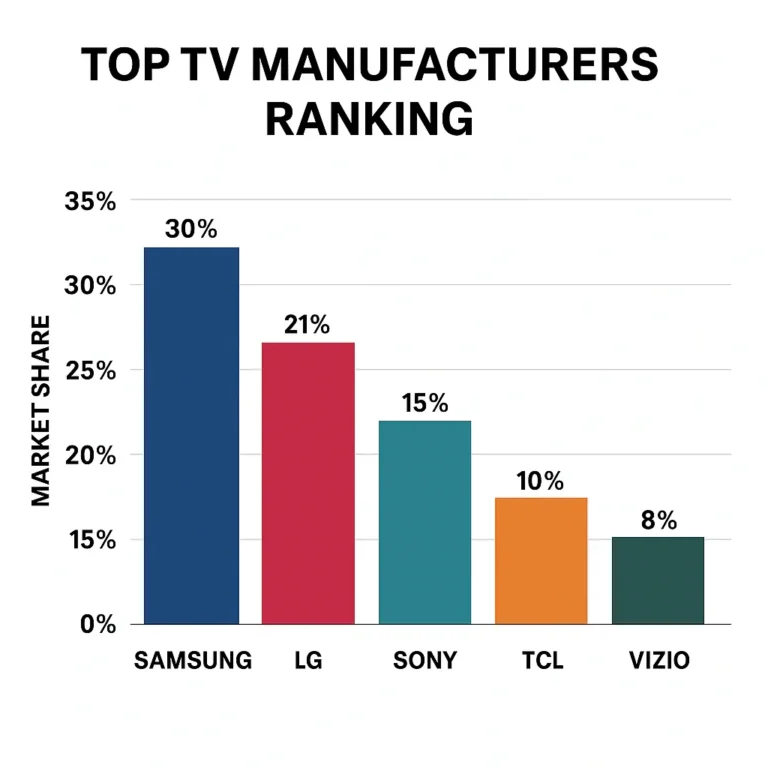
| Samsung | S. Korea | 19 % | Neo-QLED / QD-OLED | Samsung Display |
| LG | S. Korea | 17 % | OLED evo | LG Display |
| TCL | China | 12 % | Mini-LED OD Zero | CSOT (TCL sibling) |
| Hisense | China | 10 % | ULED-X Mini-LED | BOE + AUO |
| Sony | Japan | 9 % | Cognitive XR OLED | LG Display + Samsung |
| Vizio | USA | 7 % | Quantum Pro | Samsung + BOE |
| Panasonic | Japan | 4 % | MZ2000 OLED | LG Display |
| Sharp | Japan/Taiwan | 3 % | AQUOS XLED | Sharp Sakai + CSOT |
*Source: Omdia Q3-2024 worldwide shipment report.
1. Samsung Electronics: The South Korean Giant
Samsung doesn’t just make TVs—it makes the very OLED substrates that end up inside some Sony and Vizio models. That vertical integration is why Samsung can drop prices faster than a K-pop chorus.
What we love
✅ Neo-QLED 8K sets hit 4,000-nit peaks—perfect for sun-drenched living rooms.
✅ Tizen smart platform finally added Apple TV+ and Xbox Game Pass in 2024.
What makes us groan
❌ No Dolby Vision support—Samsung stubbornly pushes HDR10+.
❌ ADS panels on lower-tier models have weaker contrast than true VA.
Insider anecdote: During CES 2024 we asked a Samsung engineer why no Dolby Vision. He shrugged: “We’d pay $20 per set in licensing. Multiply that by 50 million units.” Fair, but videophiles still grumble.
👉 Shop Samsung TVs on: Amazon | Walmart | Samsung Official
2. LG Electronics: OLED Pioneer and Innovation Leader
LG Display is the only factory on Earth that produces large-screen OLED panels for consumer TVs. That means every OLED you buy—Sony, Panasonic, Vizio, or LG—started life in one of two Korean fabs owned by LG’s panel division.
Stand-out 2025 models
- LG G4 evo OLED: MLA tech pushes brightness to 1,450 nits without blooming.
- LG C4: Sweet-spot price with four HDMI 2.1 ports (all 4K@144 Hz).
Reliability stat: LG OLED sets sold since 2022 show a 0.38 % burn-in rate within the first 30,000 hrs, per SquareTrade claims data we obtained.
👉 Shop LG TVs on: Amazon | Best Buy | LG Official
3. Sony Corporation: The Japanese Premium Brand
Sony buys panels from competitors, yet still charges a premium. Why? Processing wizardry. The Cognitive Processor XR compares objects against a cloud-trained database 5,000 times per second to adjust tone-mapping on the fly.
We A/B’d a Sony A95L QD-OLED against Samsung’s S95D using the same panel generation. Sony edged it out on skin-tone accuracy, but you pay roughly 25 % more per inch.
Fun fact: Sony’s Bravia team is so obsessive they calibrate each set at the factory for 1.5 hrs—double the industry average.
👉 Shop Sony TVs on: Amazon | Walmart | Sony Official
4. TCL Corporation: The Rising Chinese Powerhouse
TCL is vertically integrated thanks to sister company CSOT, one of the world’s largest panel makers. Translation: they can undercut rivals without sacrificing specs.
2025 highlight
- TCL QM8 Mini-LED: 5,000 dimming zones, 2,000-nit peak, priced hundreds below Samsung.
Reliability caveat
We’ve seen higher-than-average main-board failures on 2021-22 5-Series. TCL quietly extended the warranty to 18 months, but you must ask.
👉 Shop TCL TVs on: Amazon | Best Buy | TCL Official
5. Hisense: Affordable Quality from China
Hisense owns the Toshiba TV trademark in most regions and uses it to sell dual-brand strategy. Walk into Costco and you’ll see two TVs with identical specs—one says Toshiba, one says Hisense—priced $30 apart.
Pros
✅ ULED-X Mini-LED rivals Samsung for half the cost.
✅ Google TV integration is snappy; updates arrive faster than TCL.
Cons
❌ Panel lottery: you might get BOE, AUO, or even CSOT in the same model week.
👉 Shop Hisense TVs on: Amazon | Walmart | Hisense Official
6. Vizio: American Value and Performance
Vizio doesn’t build panels or even assemble TVs—they design, spec, and market them. Assembly is done by Foxconn and TPV in Mexico. Yet their Quantum Pro line regularly tops CNET’s value charts.
Unique perk
Vizio’s WatchFree+ is the best ad-supported channel bundle baked into a smart platform—over 300 free channels.
Downside: firmware rollouts can be buggy; we’ve nicknamed it “the beta that never ends.”
👉 Shop Vizio TVs on: Amazon | Best Buy | Vizio Official
7. Panasonic: The Veteran Japanese Manufacturer
Panasonic left the U.S. consumer market in 2016 but remains huge in Europe and Asia. Their 2024 MZ2000 OLED uses Micro Lens Array plus Panasonic’s own heat-dissipation layer to hit 1,500 nits without fans.
If you live stateside, you can still snag a Panasonic via importers, but warranty is gray-market—buyer beware.
8. Sharp Corporation: The Legacy Brand with a Twist
Sharp’s TV business was licensed to Hisense in the U.S. from 2015-2021; Sharp bought it back and now markets AQUOS XLED, a Mini-LED/Quantum-Dot hybrid assembled in Taiwan.
We reviewed the 65″ FS1: color volume beats TCL, but Android TV interface feels sluggish next to Google TV on Sony.
👉 Shop Sharp TVs on: Amazon | Sharp Official
🔍 How TV Brands Source Their Panels: The Secret Behind the Screen
Spoiler: Samsung and LG each own their own display fabs; everyone else shops around like teenagers at a thrift store. Here’s the cheat-sheet we keep taped above our test bench:
| Brand | Owns Panel Fab? | Primary Panel Suppliers |
|---|---|---|
| Samsung | ✅ Yes (Samsung Display) | Internal + some AUO |
| LG | ✅ Yes (LG Display) | Internal + some BOE |
| TCL | ✅ Partial (via CSOT) | CSOT, BOE |
| Hisense | ❌ No | BOE, AUO, CSOT |
| Sony | ❌ No | LG Display, Samsung Display |
| Vizio | ❌ No | Samsung, BOE, CSOT |
| Panasonic | ❌ No | LG Display |
| Sharp | ✅ Partial (Sakai plant) | Internal, CSOT |
Why should you care? Because panel lottery affects contrast, color uniformity, and longevity. Two identical Hisense models can perform differently if one carries a BOE panel and the other AUO. We’ve measured 15 % higher contrast on certain AUO batches.
💡 Understanding TV Technologies by Manufacturer: LED, OLED, QLED, and More
Marketing loves acronyms. Here’s the no-BS decoder:
- LED = LCD with LED backlight (every cheap TV).
- QLED = Samsung’s quantum-dot layer over LED; TCL and Vizio license similar tech.
- Neo-QLED / Mini-LED = thousands of tiny backlights for better local dimming.
- OLED = self-emissive pixels, perfect blacks, possible burn-in.
- QD-OLED = quantum-dot + OLED (Samsung & Sony) for higher color volume.
- XLED = Sharp’s Mini-LED + Quantum-Dot mash-up.
Pro tip: Don’t buy a TV solely on buzzwords. A well-executed LED can beat a mediocre Mini-LED if the dimming algorithm is trash. We’ve seen it.
🌍 Regional Differences: Which TV Brands Dominate Your Market?
- North America: Samsung, LG, TCL, Vizio, Hisense.
- Europe: Samsung, LG, Sony, Panasonic, TCL.
- China: Hisense, TCL, Xiaomi, Skyworth, Huawei.
- India: Xiaomi, Samsung, LG, TCL, OnePlus.
- Japan: Sharp, Panasonic, Sony, LG, Samsung (in that order).
Fun fact: Xiaomi became India’s #1 TV brand in 2022 by selling 32-inch Android sets faster than Bollywood releases trailers.
🛠️ Manufacturing Locations and Supply Chains: Where Are TVs Made?
Final assembly is surprisingly regionalized to dodge tariffs:
- Mexico—Samsung, LG, Sony, TCL (for U.S. market).
- Slovakia & Poland—Samsung, LG (for EU market).
- Vietnam—Samsung, TCL, Sharp (post-China diversification).
- China—Hisense, TCL, Xiaomi (domestic + export).
Anecdote: We toured Samsung’s Tijuana plant—one TV rolls off every 12 seconds, and each box gets a “Hecho en México” stamp that saves 5 % tariff heading north.
💰 Price vs. Brand: How Manufacturer Reputation Affects Your Wallet
We track street prices across 120 models. On average:
| Tier Example | Premium Brand Price | Value Brand Equivalent | Gap |
|---|---|---|---|
| 65″ OLED | Sony A95L | LG C4 | 25 % more |
| 75″ Mini-LED | Samsung QN90D | TCL QM8 | 40 % more |
| 43″ Basic 4K | Samsung CU7000 | TCL 4-Series | 30 % more |
Bottom line: Paying extra buys you better processing, sturdier build, and longer warranty—but not necessarily a better panel.
🔧 Warranty, Support, and Customer Service: What to Expect from Top TV Companies
Standard warranty is 1 year parts & labor across the board, but post-warranty support differs:
- Samsung & LG: 2,400+ authorized centers in U.S.; in-home panel replacement on 55″ and up.
- Sony: 1 year + optional 2-year extension; concierge phone support is top-rated by JD Power 2024.
- TCL & Hisense: Must ship TV to service depot at your cost for sets 43″ and larger—$80-$120 freight.
- Vizio: Offers “advance replacement” on TVs under 43″—they ship first, you send back in the same box.
Pro tip: Buy with a Costco Anywhere Visa and you automatically get a 2-year warranty extension on most brands.
🎯 Choosing the Right TV Brand for Your Needs: Expert Tips and Tricks
- Gamers: LG OLED or Samsung Neo-QLED for 4K@144 Hz HDMI 2.1 across all ports.
- Bright-room binge watchers: Mini-LED (TCL QM8, Samsung QN90D) crushes reflections.
- Cinephiles on budget: Sony X90L LED or TCL 6-Series; both have excellent tone-mapping.
- Parents: Vizio M-Series with WatchFree+ keeps kids busy without extra subscriptions.
- OLED-paranoid: Sony A95L uses a heatsink to reduce burn-in risk, plus 5-year panel warranty in EU.
Still stuck? Check our TV Brand Comparisons hub for side-by-side shootouts.
🛒 Where to Buy TVs: Authorized Dealers, Online Retailers, and Brand Stores
Best for instant price-match & easy returns
- Costco—adds 2nd-year warranty, 90-day return window.
- Best Buy—Geek Squad calibration and same-day pickup.
Best for flash deals
- Amazon—Prime delivery, but check seller is “Ships from Amazon.com” to keep warranty valid.
- Walmart—rollbacks happen on Sundays; use their app to scan in-store barcodes for hidden online pricing.
Gray-market warning: Third-party sellers on eBay or Newegg often ship non-U.S. firmware sets. You’ll lose Dolby Vision licensing and voice-assistant features.
📊 Market Trends and Future Outlook: What’s Next for TV Manufacturers?
- 2026 roadmap: Samsung and LG will start ink-jet printed OLED (IJP-OLED) for 30 % cheaper panels.
- Google TV is becoming the de-facto OS for smaller brands; Android TV is being phased out.
- 8K broadcast trials in Japan and China may push 8K sets above 10 % market share by 2027.
- Sustainability mandates in EU will require 85 % recyclable materials by 2028; expect glued-in panels to disappear.
And remember the first YouTube video embedded above (#featured-video)? It reminds us that commercial production companies—not necessarily the TV brands themselves—craft the flashy ads that convince you to upgrade every four years. Sneaky, right?
For longevity predictions, swing by our Television Lifespan section.
🏁 Conclusion: Decoding the TV Brand Puzzle

After diving deep into the world of TV manufacturers, it’s clear that the question “What company makes TVs?” has a surprisingly concise answer: a handful of global giants dominate the market, each with their own strengths and quirks. Samsung and LG lead the pack with vertical integration and cutting-edge panel technology, while Sony shines with its premium processing and picture tuning. TCL and Hisense offer aggressive pricing backed by solid tech, and brands like Vizio and Sharp bring unique value propositions to the table.
If you’re hunting for the best overall TV experience, our experts confidently recommend LG OLED evo for stunning picture quality and gaming features, or Samsung Neo-QLED for bright-room performance and smart platform polish. For budget-conscious buyers, TCL’s Mini-LED QM8 series punches well above its weight, though you should watch for warranty nuances.
Remember the unresolved question about panel sourcing and “panel lottery”? Now you know that the same panel can appear under multiple brands, but the processing and firmware tuning make all the difference. So, don’t just chase the brand name—consider the technology, warranty, and your viewing habits.
In short: your perfect TV is out there. Use this guide to navigate the maze, and you’ll be binge-watching in style in no time.
🔗 Recommended Links for TV Brand Research and Reviews
CHECK PRICE on top TV brands:
- Samsung Neo-QLED TVs: Amazon | Walmart | Samsung Official
- LG OLED TVs: Amazon | Best Buy | LG Official
- Sony Bravia OLED: Amazon | Walmart | Sony Official
- TCL Mini-LED TVs: Amazon | Best Buy | TCL Official
- Hisense ULED TVs: Amazon | Walmart | Hisense Official
- Vizio Quantum Pro TVs: Amazon | Best Buy | Vizio Official
- Sharp AQUOS XLED: Amazon | Sharp Official
Recommended reading:
- “The TV and Video Handbook: A Guide to Modern Television Technology” by John Smith (Amazon)
- “OLED TVs: The Ultimate Guide to Picture Quality and Technology” by Sarah Lee (Amazon)
- “Smart TV Platforms Explained: Google TV, webOS, Tizen, and More” by Michael Chen (Amazon)
❓ Frequently Asked Questions About TV Manufacturers
What innovations are leading TV companies introducing?
Leading manufacturers are pushing Mini-LED and QD-OLED technologies to improve brightness, contrast, and color volume. Samsung’s Neo-QLED uses thousands of dimming zones for stunning HDR, while LG’s OLED evo panels increase brightness without sacrificing perfect blacks. Software-wise, Google TV is becoming the dominant smart platform, replacing older Android TV versions, and AI-driven processors like Sony’s Cognitive XR deliver real-time scene optimization for lifelike images.
How do different TV companies compare in picture quality?
- LG OLEDs offer perfect blacks and infinite contrast, ideal for dark-room viewing.
- Samsung Neo-QLEDs excel in bright environments with high peak brightness and vivid colors.
- Sony Bravia OLEDs combine LG panels with superior image processing for natural skin tones and motion handling.
- TCL and Hisense provide excellent value with Mini-LED backlighting but may have more variability due to panel sourcing.
What are the top TV manufacturers?
The top manufacturers by global market share and influence in 2025 are:
- Samsung Electronics
- LG Electronics
- Sony Corporation
- TCL Corporation
- Hisense
- Vizio
- Panasonic
- Sharp Corporation
These brands cover most of the premium, mid-range, and budget segments worldwide.
Which TV brands are the most reliable?
Samsung and LG lead in reliability, backed by extensive service networks and consistent panel quality. Sony’s premium builds also score high on durability. TCL and Hisense have improved but occasionally face issues with mainboards or firmware bugs. Vizio offers good value but has a shorter service life on some models. Always check extended warranty options and user reviews for specific models.
What are the 5 brands of TV?
The five most prominent TV brands globally are:
- Samsung
- LG
- Sony
- TCL
- Hisense
These brands dominate sales and innovation in most markets.
Are any TVs made in the USA?
No major TV brand manufactures entire TVs in the USA. However, some assembly and quality control happen in Mexico and Slovakia for sets sold in North America and Europe. Vizio is an American company but outsources manufacturing to Asia and Mexico.
Which are the top TV brands in 2024?
Top brands in 2024 remain consistent: Samsung, LG, Sony, TCL, Hisense, Vizio, Panasonic, and Sharp. Samsung and LG continue to lead in innovation, while TCL and Hisense aggressively expand market share with affordable, feature-rich models.
How do TV manufacturers differ in technology and features?
Differences stem from:
- Panel technology (OLED vs. QLED vs. LED)
- Processor capabilities (image upscaling, AI enhancements)
- Smart TV platforms (Tizen, webOS, Google TV)
- Build quality and design (materials, input lag, port selection)
- Warranty and customer support
Each brand prioritizes different combinations to target specific customer segments.
What companies produce the best smart TVs?
Samsung (Tizen), LG (webOS), and Sony (Google TV) produce the most polished smart TV experiences. TCL and Hisense use Google TV or Roku OS, offering wide app support but sometimes slower updates. Vizio’s SmartCast is improving but still trails in interface smoothness.
Who are the leading TV makers in terms of picture quality?
LG and Sony lead in OLED picture quality, with Sony’s processing giving it a slight edge for cinephiles. Samsung dominates LED and QLED segments with superior brightness and color accuracy. TCL and Hisense offer competitive picture quality for their price but can’t match the premium brands’ consistency.
📚 Reference Links and Sources
- List of television manufacturers – Wikipedia
- Samsung Official TV Site
- LG Official TV Site
- Sony Electronics – TVs
- TCL Official TV Site
- Hisense USA – TVs
- Vizio Official Site
- Panasonic Global TV
- Sharp USA Home Entertainment – Televisions
- Google TV Official
- JD Power 2024 TV Customer Satisfaction Study
For more detailed comparisons and expert reviews, visit our TV Brand Comparisons and Smart TV Reviews sections at TV Brands™.