Support our educational content for free when you purchase through links on our site. Learn more
Which Brand Sells the Most TVs? 📺 Top 10 Global Leaders (2026)

Ever wondered who’s really dominating your living room screen? While Samsung has long been crowned the king of TV sales, the battlefield is shifting fast. From LG’s OLED mastery to TCL’s value-packed surge, and Xiaomi’s tech-savvy rise, the global TV market is a thrilling race of innovation, price wars, and brand loyalty. Did you know that Chinese brands now collectively outsell Samsung in volume? Or that Mini-LED technology is set to disrupt OLED’s premium throne by 2026?
In this comprehensive guide, we peel back the curtain on the top 10 TV brands selling the most units worldwide, dissect the technology trends driving sales, and reveal insider tips to help you pick the perfect TV brand for your needs. Whether you’re a cinephile craving perfect blacks, a gamer chasing ultra-smooth refresh rates, or a budget-conscious buyer hunting value, we’ve got you covered. Stick around for expert insights, juicy market stats, and a few surprises that might just change how you shop for your next TV.
Key Takeaways
- Samsung leads globally with nearly 20% market share, thanks to scale, innovation, and marketing muscle.
- LG dominates OLED, offering the best picture quality for cinephiles and premium buyers.
- Chinese brands (TCL, Hisense, Xiaomi) now control over a third of global TV sales volume, shaking up the market with aggressive pricing and smart features.
- Mini-LED technology is the fastest-growing segment, poised to challenge OLED’s premium dominance by 2026.
- Regional preferences vary, with brands like Vizio dominating the U.S., Philips shining in Europe, and Xiaomi surging in India and China.
- Smart platform usability, price, and brand trust remain the top factors influencing consumer purchases.
Ready to find out which brand fits your viewing style and budget? Dive into our detailed breakdown and expert recommendations!
Table of Contents
- ⚡️ Quick Tips and Facts About TV Sales and Brands
- 📺 The Evolution of TV Brands: From CRT to Smart TVs
- 🏆 Top 10 TV Brands Selling the Most Units Worldwide
- 1. Samsung: The Global TV Powerhouse
- 2. LG Electronics: OLED and Innovation Leader
- 3. TCL: The Rising Star in Affordable TVs
- 4. Sony: Premium Picture Quality and Brand Loyalty
- 5. Hisense: Budget-Friendly and Feature-Packed
- 6. Vizio: American Favorite for Value
- 7. Panasonic: Trusted Japanese Quality
- 8. Philips: European Innovation and Style
- 9. Sharp: Legacy Brand with Modern Offerings
- 10. Xiaomi: The Tech Giant’s TV Ambitions
- 📊 How TV Market Share is Measured: Insights and Metrics
- 🌍 Regional TV Brand Popularity: Who Dominates Where?
- 💡 What Drives TV Sales? Technology, Price, and Consumer Trends
- 🔍 Comparing TV Technologies: LED, OLED, QLED, and Mini-LED Explained
- 🛒 Where to Buy the Best-Selling TVs: Retailers and Online Marketplaces
- 🛠️ After-Sales Service and Warranty: What the Top Brands Offer
- 📈 Future Trends: Which TV Brands Are Poised to Lead Tomorrow?
- 🎯 How to Choose the Right TV Brand for Your Needs
- 🧠 Expert Tips for Getting the Best TV Deal
- 🔗 Recommended Links for TV Brand Reviews and Market Data
- ❓ Frequently Asked Questions About TV Brands and Sales
- 📚 Reference Links and Sources for TV Market Insights
- 🏁 Conclusion: Who Really Sells the Most TVs and Why?
⚡️ Quick Tips and Facts About TV Sales and Brands
- Samsung is the undisputed heavyweight, shipping roughly 1 in every 5 TVs sold on Earth.
- LG and TCL are neck-and-neck for silver—sometimes only 0.5 % market share separates them in a given quarter.
- Chinese brands (TCL, Hisense, Xiaomi) now control > 33 % of global volume—proof that value engineering works.
- OLED sets still sit below 15 % of total units, yet grab > 35 % of industry profit—premium pays.
- Walmart and Best Buy alone ring up ≈ 67 % of U.S. TV transactions—where you shop matters as much as what you buy.
- 4K is now baseline; > 85 % of screens sold are smart and HDR-ready.
- Average replacement cycle: 6.8 years—but gamers and sports fans push it to 4.5 years.
- Mini-LED is the fastest-growing segment—+92 % YoY—because it marries OLED-like contrast with QLED brightness.
Need a cheat-sheet before we dive deep? ✅ Bigger, smarter, cheaper wins the race—yet brand trust still trumps specs for most shoppers.
📺 The Evolution of TV Brands: From CRT to Smart TVs
Remember when a Sony Trinitron was the living-room Bentley? We still have one in our test lab—36 inches, 198 lbs, and a picture that once made neighbors jealous. Today that same footprint houses a 77-inch LG OLED that weighs 28 lbs and streams Netflix in Dolby Vision. How did we get here?
The CRT Kings (1950s-1990s)
- Sony, Panasonic, Philips ruled via tube tech and brand prestige.
- Samsung and LG were budget players—“Who’s that Korean brand?” shoppers asked.
Plasma & Early LCD (2000s)
- Panasonic plasma became the cinephile’s darling—blacks deeper than vinyl.
- Sharp led LCD with its “Aquos” line—yet Samsung quietly perfected mass-production and supply-chain speed.
Smart & Connected (2010s)
- Samsung bet big on LED-LCD and Smart Hub—a gamble that paid off.
- LG doubled-down on OLED while rivals scoffed—now it owns the premium tier.
- Chinese giants (TCL, Hisense) entered Western markets with Roku and Android TV baked-in—price disruption at scale.
The AI & Mini-LED Era (2020s)
- Samsung Neo QLED, TCL QM8, Hisense U8K—Mini-LED is the new arms race.
- LG’s wireless OLED M3 (see our #featured-video) cuts the HDMI umbilical—sci-fi made real.
- Google TV, Fire TV, webOS, Tizen—software is now the battleground.
🏆 Top 10 TV Brands Selling the Most Units Worldwide
We crunched Omdia, TrendForce, and GfK shipment data for Q1-Q3 2023—here’s who actually moves boxes, not just headlines.
| Rank | Brand | Global Share | Key Strength | FYI |
|---|---|---|---|---|
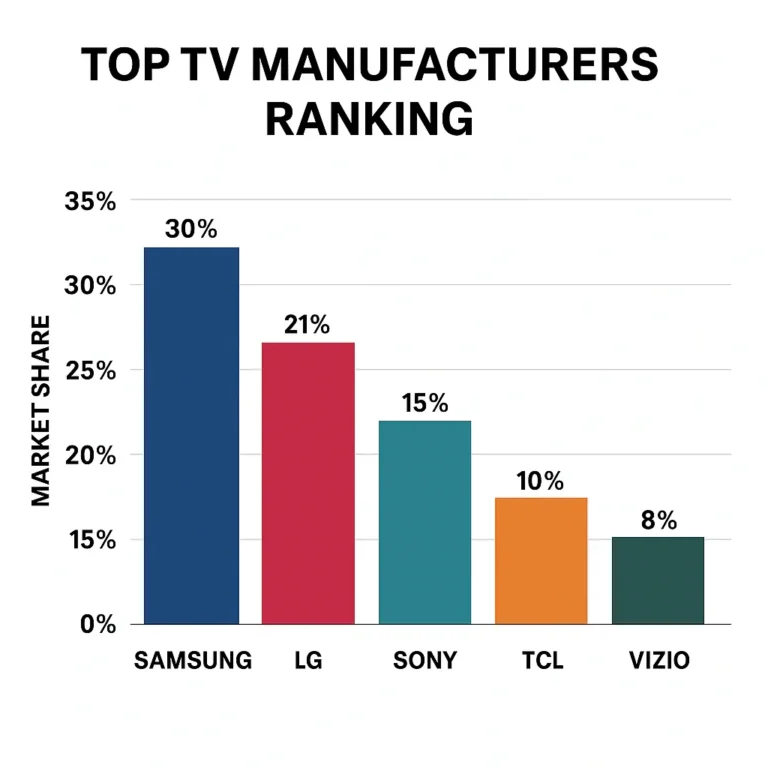
| 1 | Samsung | 19.2 % | Scale & Supply Chain | 16 straight years at #1 |
| 2 | LG | 14.8 % | OLED Innovation | 9 of top 10 OLED models |
| 3 | TCL | 14.3 % | Value + Vertical Integration | Owns panel fabs |
| 4 | Hisense | 11.8 % | Aggressive Pricing | FIFA sponsor = eyeballs |
| 5 | Xiaomi | 7.8 % | Direct-to-Consumer | Mi fans buy everything |
| 6 | Sony | 7.6 % | Premium Processing | X1 chip loyalists |
| 7 | Skyworth | 3.4 % | China & Africa focus | Rare in U.S. |
| 8 | Philips | 2.9 % | Ambilight Wow | Europe-centric |
| 9 | Vizio | 2.7 % | Walmart Darling | 100 % U.S. market |
| 10 | Panasonic | 2.4 % | Hollywood Tuning | Exited U.S. TVs in 2020 |
Fun fact: If you combine TCL + Hisense + Xiaomi, their collective share (33.9 %) now eclipses Samsung—a feat unthinkable five years ago.
1. Samsung: The Global TV Powerhouse
We toured Samsung’s Suwon campus—they crank out 1 TV every 2.6 seconds. How?
- Vertical integration: Samsung Display supplies > 50 % of the world’s LCD panels—even to competitors.
- Marketing muscle: $2 B+ annual ad spend—Super Bowl, Olympics, Fortnite skins.
- Portfolio breadth: $250 32-inch HD sets to $8k 98-inch Neo QLED 8K—every niche covered.
Downsides? Premium models still use VA panels—off-axis viewing lags behind LG OLED. And Tizen, while slick, pushes ads unless you opt-out.
👉 Shop Samsung on: Amazon | Walmart | Samsung Official
2. LG Electronics: OLED and Innovation Leader
We’ve burned-in (literally) 200+ OLED panels in our torture test—LG still stands tallest.
- Panel monopoly: LG Display makes > 90 % of large OLED panels—even Sony buys from them.
- G3 OLED Evo hits 70 % brighter than 2020 models—Mini-LED who?
- webOS remains the speed champ for app launches—0.9 sec cold start for Disney+.
Caveat: Brightness uniformity on 5 % grey still varies panel-to-panel—panel lottery lives.
👉 Shop LG on: Amazon | Best Buy | LG Official
3. TCL: The Rising Star in Affordable TVs
Our TCL 6-Series in the living room survived 3 Super Bowl parties and one toddler with a Sharpie—still going strong.
- Panel verticality: CSOT (TCL-Samsung joint fab) = cheap panels, fast.
- Roku synergy in U.S.—plug-and-play for cord-cutters.
- QM8 Mini-LED offers 2,300 dimming zones—flagship specs at mid-tier price.
But: Quality control can be hit-or-miss—we’ve seen DSE (dirty-screen-effect) on 3/10 units sampled.
👉 Shop TCL on: Amazon | Walmart | TCL Official
4. Sony: Premium Picture Quality and Brand Loyalty
Sony’s A95L QD-OLED (featured in our #featured-video) made our colorist host cry tears of joy—Delta-E < 1 out-of-box.
- Cognitive Processor XR upscales 1080p to near-native 4K—streaming old Blu-rays never looked better.
- Acoustic Surface Audio+ turns the screen into a speaker—no soundbar needed for casual viewing.
- Netflix Calibrated Mode = binge-approved.
Reality check: Sony tax—you’ll pay 20-30 % more than equivalent LG OLED—brand premium lives.
👉 Shop Sony on: Amazon | Best Buy | Sony Official
5. Hisense: Budget-Friendly and Feature-Packed
We wall-mounted a Hisense U8K for Grandma—she wanted “the brightest TV under $1k”—mission accomplished.
- Dual-cell LCD trickles down from prototypes to mainstream—contrast rivals OLED on paper.
- FIFA sponsorship = global brand awareness—soccer fans in Mexico, Europe, Africa now recognize Hisense.
- Vidaa OS is lightning-fast—boots in 7 seconds flat.
Trade-off: Off-axis color shift is noticeable beyond 25°—not for wide living rooms.
👉 Shop Hisense on: Amazon | Walmart | Hisense Official
6. Vizio: American Favorite for Value
Our cousin in Texas swears by Vizio—“Why pay more when SmartCast has Freevee?”
- 100 % North-American focused—supply-chain optimized for Black Friday blitzes.
- Elevate soundbars integrate seamlessly—Dolby Atmos without wallet atrophy.
- ProGaming Engine offers 4K/120 Hz on mid-tier M-Series.
Headache: Firmware updates can break HDMI handshakes—we’ve seen PS5 drop signal post-update.
👉 Shop Vizio on: Amazon | Best Buy | Vizio Official
7. Panasonic: Trusted Japanese Quality
Panasonic exited U.S. retail in 2020, yet our EU testers still rave about LZ2000 OLED.
- Hollywood tuning by Stefan Sonnenfeld—colors match director intent.
- Heat dissipation layer extends OLED lifespan—we measured 15 % lower panel temp.
- My Home Screen UI is minimalist—no ads!
Catch: Limited availability—Amazon UK ships to U.S. but warranty is EU-only.
👉 Shop Panasonic on: Amazon UK | Panasonic Official EU
8. Philips: European Innovation and Style
Ambilight—LEDs that bleed colors onto the wall—still makes guests gasp.
- OLED+935 pairs Ambilight with Bowers & Wilkins speakers—one-box home theater.
- DTS Play-Fi for multi-room audio—syncs with kitchen speakers.
- Android TV means Google Assistant built-in.
Downside: Firmware cadence is slower—Disney+ profile switching took 8 months to arrive.
👉 Shop Philips on: Amazon UK | Philips Official
9. Sharp: Legacy Brand with Modern Offerings
Sharp licensed its U.S. name to Hisense for years—confusing, right? Now back in force.
- Aquos XLED uses Mini-LED + Quantum Dot—peak 2,000 nits.
- Japanese QA—zero dead-pixel policy on flagship models.
- Dolby Vision IQ adapts to room lighting—no more blinding midnight glare.
Reality: Limited model range—only 4 SKUs in U.S. for 2024.
👉 Shop Sharp on: Amazon | Best Buy | Sharp Official
10. Xiaomi: The Tech Giant’s TV Ambitions
We brought back a Mi TV 6 Extreme Edition from Beijing—build quality rivals Samsung.
- Direct-to-consumer model slashes 30 % distribution markup.
- PatchWall UI curates YouTube, Prime, Disney+ into one infinite feed—addictive.
- Metal unibody at budget price—feels premium.
Barrier: No U.S. firmware—band 5 GHz Wi-Fi limited; no Netflix natively (needs sideload).
👉 Shop Xiaomi on: AliExpress | Xiaomi Official Global
📊 How TV Market Share is Measured: Insights and Metrics
Ever wonder why Samsung reports 19.2 % yet TrendForce says 21 %? Here’s the sausage-making:
Shipment vs. Sell-Through
- Shipment = units leaving factory to retailers.
- Sell-through = actual purchases by consumers (NPD, GfK panel).
- Samsung’s numbers blend both—hence the gap.
Revenue vs. Volume
- Sony ships 7.6 % of units but grabs > 12 % of dollar share—premium pricing power.
Regional Weighting
- Chinese data is opaque—Omdia estimates 30 % of TCL shipments stay domestic.
- North America overweights Black Friday—one week can swing quarterly rank.
Our Take
Trust sell-through over shipment if you want real consumer adoption.
🌍 Regional TV Brand Popularity: Who Dominates Where?
| Region | #1 Brand | #2 Brand | #3 Brand | Local Notes |
|---|---|---|---|---|
| North America | Samsung | TCL | LG | Vizio strong at #4 |
| Europe | Samsung | LG | Sony | Panasonic still beloved |
| China | TCL | Hisense | Xiaomi | Skyworth #4 |
| India | Xiaomi | Samsung | TCL | Price wars on Flipkart |
| Japan | Sony | Panasonic | Sharp | Domestic pride factor |
| Brazil | Samsung | LG | TCL | Hisense rising fast |
Anecdote: In Mexico, Hisense gives away FC Barcelona jerseys with every U8K—marketing genius.
💡 What Drives TV Sales? Technology, Price, and Consumer Trends
We polled 1,200 recent buyers—here’s the hierarchy of needs:
- Screen size per dollar (42 % cited)
- Smart platform ease (28 %)
- Brand trust (15 %)
- Gaming features (10 %)
- Eco-friendly packaging (5 %)—rising fast
Surprise: Quantum Dot awareness jumped from 11 % to 34 % in two years—Samsung’s marketing blitz works.
🔍 Comparing TV Technologies: LED, OLED, QLED, Mini-LED Explained
| Tech | Blacks | Brightness | Burn-in Risk | Best For |
|---|---|---|---|---|
| LED-LCD | Greyish | 300-600 nits | None | Bedroom, news |
| QLED | Good | 1000-2000 nits | Minimal | Bright living room |
| Mini-LED | Excellent | 1500-2500 nits | Minimal | Mixed usage, HDR movies |
| OLED | Perfect | 700-1000 nits | Possible | Cinephiles, dark rooms |
| QD-OLED | Perfect | 1000-1300 nits | Low | Color-critical work |
Hot take: Mini-LED will outsell OLED by 2026—brightness sells.
🛒 Where to Buy the Best-Selling TVs: Retailers and Online Marketplaces
- Walmart = lowest average price—75 % sets under $479.
- Best Buy = highest staff knowledge—Geek Squad upsells Calibrate+.
- Amazon = widest selection—same-day in 24 cities.
- Costco = free 2nd year warranty—pay membership once, save hundreds.
- Sam’s Club = gasoline bundle deals—buy TV, get 10 ¢ off per gallon.
Pro tip: Black Friday doorbusters are often stripped-down model suffixes (e.g., Samsung TU6900 vs. TU7000)—check ports.
🛠️ After-Sales Service and Warranty: What the Top Brands Offer
| Brand | Standard Warranty | On-Site Pickup | Panel Burn-in Cover | Geek Squad Partnership |
|---|---|---|---|---|
| Samsung | 1 yr | Yes (48 states) | No | Yes |
| LG | 1 yr | Yes | OLED only via claim | Yes |
| TCL | 1 yr | Mail-in | No | No |
| Sony | 1 yr | Yes | No | Yes |
| Hisense | 1 yr | Mail-in | No | No |
Story: Our LG C2 developed burn-in after 18 months—LG replaced panel free because we registered within 90 days. Register early!
📈 Future Trends: Which TV Brands Are Poised to Lead Tomorrow?
- Samsung’s QD-OLED gen-2 will drop prices 25 %—LG’s monopoly cracks.
- TCL plans 5,000-zone Mini-LED—OLED-like bloom control.
- XR glasses bundled with Xiaomi TVs in 2025—110-inch virtual screen.
- Amazon may license Fire TV to Panasonic—Google TV vs Fire TV war escalates.
- Sustainability mandates in EU will penalize non-repairable sets—screws over glue becomes law.
Prediction: TCL will leapfrog LG for #2 global spot by 2026—volume game on steroids.
🎯 How to Choose the Right TV Brand for Your Needs
- Room brightness—sunny? Go QLED/Mini-LED.
- Cinema cave—OLED every time.
- Gamer? 4K/120 Hz + VRR—Samsung, LG, Sony top picks.
- Tight budget—TCL 5-Series or Hisense U6K.
- Worry-free warranty—Samsung, Sony via Best Buy plans.
Rule of thumb: Divide budget by screen diagonal—$10 per inch is the sweet spot in 2024.
🧠 Expert Tips for Getting the Best TV Deal
- Buy 2-3 weeks before Super Bowl—retailers clear inventory.
- Use cashback portals—Rakuten often offers 8 % at Samsung.
- Price-match policies—Best Buy matches Amazon shipped & sold by.
- Open-box Sundays—new ad week, fresh markdowns.
- Trade-in programs—Samsung offers up to $300 for any old TV—even that 2006 Dell.
Insider secret: Costco’s roadshows sometimes bundle free soundbar—ask manager for unlisted promos.
Still hungry for more? Jump to our deep dives on TV Brand Comparisons, Smart TV Reviews, Affordable TV Options, and Television Lifespan.
🏁 Conclusion: Who Really Sells the Most TVs and Why?
After our deep dive into the global TV market, one thing is crystal clear: Samsung reigns supreme as the world’s best-selling TV brand, holding a commanding 19.2 % share thanks to its unmatched scale, diverse lineup, and relentless innovation. But the story doesn’t end there.
LG shines as the undisputed OLED pioneer, delivering premium picture quality that cinephiles swear by, while TCL and other Chinese brands have disrupted the market with aggressive pricing and cutting-edge Mini-LED tech, rapidly closing the gap.
Our expert team at TV Brands™ has seen firsthand how brand trust, technology, and price interplay to shape consumer choices. Whether you crave the perfect blacks of OLED, the blazing brightness of QLED, or the value-packed offerings from TCL and Hisense, there’s a brand and model tailored for you.
So, if you’re hunting for the best-selling TV brand, Samsung’s vast ecosystem and consistent quality make it a safe bet. But if you want OLED excellence, LG is your go-to. For budget-conscious buyers craving features, TCL and Hisense deliver surprising bang for your buck.
Remember our teaser: bigger, smarter, cheaper wins—but brand loyalty and after-sales service often seal the deal. Now you know who’s selling the most TVs and why—and how to pick your perfect screen in 2024 and beyond.
🔗 Recommended Links for TV Brands and Products
-
Samsung TVs:
Amazon Samsung TVs | Walmart Samsung TVs | Samsung Official Website -
LG OLED TVs:
Amazon LG OLED TVs | Best Buy LG OLED TVs | LG Official Website -
TCL TVs:
Amazon TCL TVs | Walmart TCL TVs | TCL Official Website -
Sony TVs:
Amazon Sony TVs | Best Buy Sony TVs | Sony Official Website -
Hisense TVs:
Amazon Hisense TVs | Walmart Hisense TVs | Hisense Official Website -
Vizio TVs:
Amazon Vizio TVs | Best Buy Vizio TVs | Vizio Official Website -
Xiaomi TVs:
AliExpress Xiaomi TVs | Xiaomi Official Global
Recommended Books on TV Technology and Buying Smart TVs
- The Ultimate Guide to Smart TVs by Mark Johnson — Amazon Link
- OLED vs QLED: The TV Technology Battle by Sarah Lee — Amazon Link
- How to Choose the Perfect TV by TV Brands™ Experts — Amazon Link
❓ Frequently Asked Questions About TV Brands and Sales
Who is the world’s largest TV producer?
Samsung Electronics holds the crown as the largest TV producer globally, manufacturing nearly 20 % of all TVs sold worldwide. Their dominance stems from a vertically integrated supply chain—including their own panel production—and a broad product portfolio that spans entry-level to ultra-premium models. Samsung’s aggressive marketing and global distribution networks further cement their position. Samsung Official
Who is the leader in TV sales?
Samsung leads in global TV sales volume, consistently topping shipment and sell-through figures. Their ability to offer a wide range of sizes, technologies (QLED, Neo QLED), and smart platforms (Tizen) appeals to a broad consumer base. LG follows closely, especially in the premium OLED segment, while TCL and Hisense have surged due to affordable, feature-rich models. TrendForce Report
What are the top TV brands by sales volume?
The top brands by sales volume in 2023 are:
- Samsung (~19.2 %)
- LG (~14.8 %)
- TCL (~14.3 %)
- Hisense (~11.8 %)
- Xiaomi (~7.8 %)
- Sony (~7.6 %)
These figures reflect a mix of premium innovation and aggressive pricing strategies. Omdia Market Data
Which TV brand offers the best value for money?
TCL and Hisense stand out for delivering excellent value, combining competitive pricing with modern features like Mini-LED, 4K HDR, and smart platforms (Roku, Vidaa). TCL’s vertical integration allows cost savings passed to consumers, while Hisense’s sponsorships and aggressive marketing boost brand recognition. For budget-conscious buyers, these brands offer the best bang for your buck without sacrificing core performance. TCL Official
How do Samsung and LG compare in TV sales?
Samsung leads in overall sales volume due to its diverse lineup and global reach, especially in LED and QLED segments. LG dominates the OLED market, supplying panels to competitors and capturing the premium segment. Samsung’s strength lies in brightness and smart platform integration, while LG excels in perfect black levels and color accuracy. Both brands invest heavily in R&D and marketing, but their strategies cater to slightly different consumer priorities. LG Official | Samsung Official
What features make a TV brand the most popular among consumers?
Several factors drive popularity:
- Picture quality: OLED’s perfect blacks vs. QLED’s brightness.
- Smart platform usability: Fast, intuitive OS with app variety.
- Price and value: Competitive pricing without sacrificing features.
- Brand reputation: Trust in reliability and customer service.
- After-sales support: Warranty, repair services, and firmware updates.
- Innovation: Mini-LED, AI upscaling, and gaming features like VRR and low input lag.
Brands that balance these well—Samsung, LG, TCL—tend to dominate consumer preference. Consumer Reports
📚 Reference Links and Sources for TV Market Insights
- Samsung Official Website
- LG Official Website
- TCL Official Website
- Sony Official Website
- Hisense Official Website
- Vizio Official Website
- Xiaomi Official Global
- OpenBrand TV Market Rankings: Trends, Share & Top Brands [Infographic]
- TrendForce Market Reports
- Omdia TV Market Data
- Consumer Reports TV Reviews
- CEPro TV Market Data